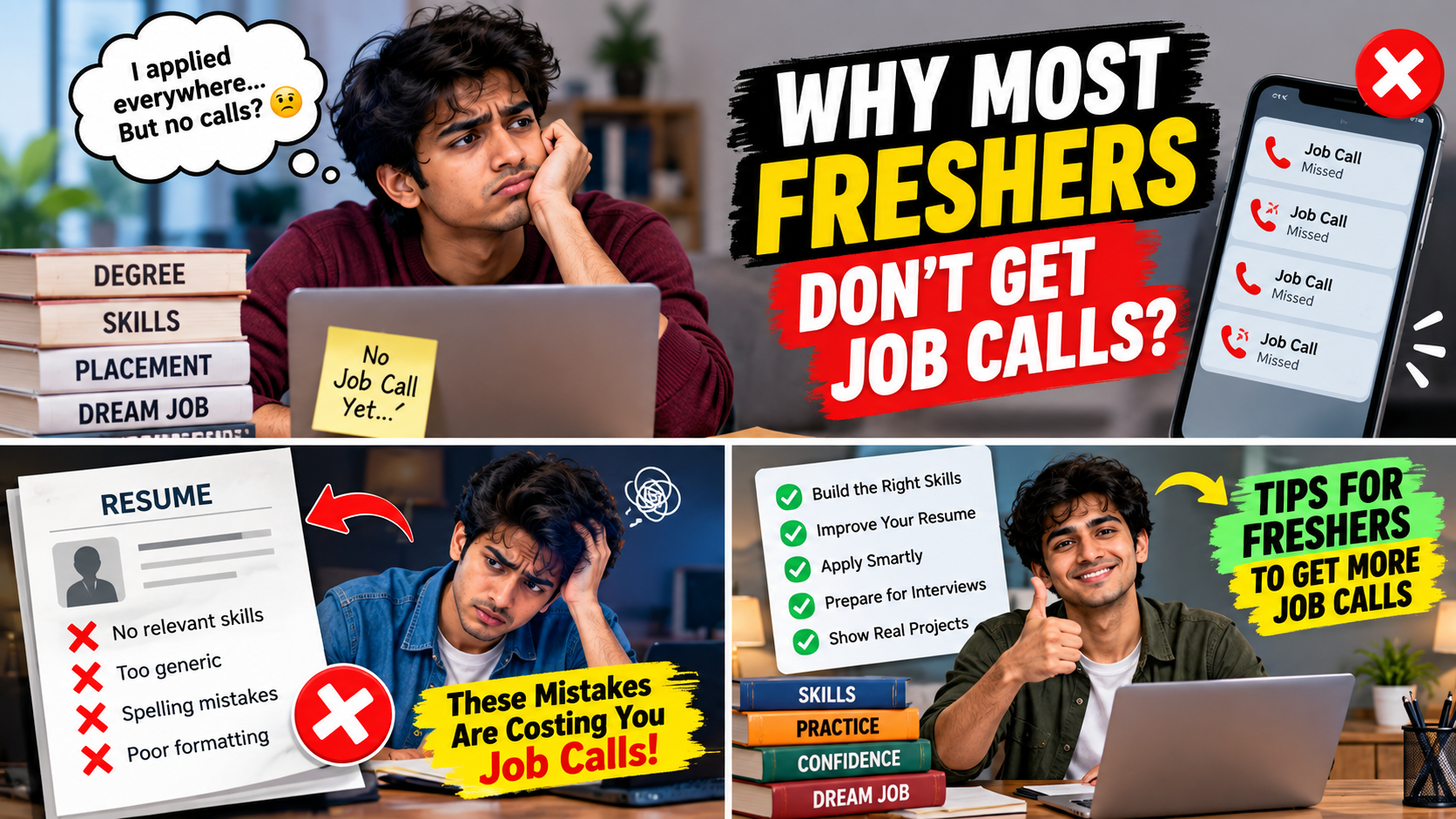

You have completed your degree. You made a resume. You created accounts on job portals. You applied to 20, 50, maybe even 100 jobs.
And then…
Silence.
No call.
No email.
No “Congratulations, we would like to invite you for an interview.”
Sometimes, you don’t even get a rejection email. Your application simply disappears into the mysterious black hole of the internet.
If this sounds familiar, don’t worry. You are not the only one.
There are many reasons why freshers don’t get job calls, and having no experience is only one small part of the problem.
The good news is that most of these problems can be fixed.
Your degree is not useless. Your career is not finished. And no, you don’t need to become a millionaire entrepreneur by Monday just because you didn’t get a job call this week.
What you need is a better strategy.
In this article, we will talk about the real reasons freshers struggle to get interview calls and, more importantly, what you can do about them.
Table of Contents
1. Your Resume Is Too Generic
Let’s start with the biggest problem.
A lot of freshers create one resume and send exactly the same file to every company.
Software Developer ?
Same resume.
Digital Marketing ?
Same resume.
HR Executive ?
Same resume.
Sales job?
Yep, same resume.
This is where things start going wrong.
A recruiter is looking for candidates who match a particular job. Your resume should make that match easy to see.
For example, imagine a company is looking for a junior digital marketing executive.
The job description mentions:
- SEO
- Google Analytics
- Social media
- Content writing
- Keyword research
But your resume only says:
“Hardworking, punctual and passionate graduate looking for a challenging opportunity.”
Sounds nice.
But the recruiter is probably thinking:
“Okay… but what can this person actually do ?”
That’s the problem.
Your resume should focus on useful skills and proof.
Instead of:
Hardworking and quick learner.
Write something more specific:
Created SEO – friendly blog content and performed basic keyword research for personal projects.
That tells the recruiter something useful.
Indeed also recommends that fresher resumes clearly highlight relevant skills, education and qualifications instead of simply focusing on the lack of work experience.
Read also :- How to Get Freelance Jobs from Home in 2026
2. You Are Applying for Everything
This is another very common mistake.
You wake up.
Open a job portal.
Search “fresher jobs.”
Apply.
Next.
Apply.
Next.
Apply again.
After two hours, you have applied to 35 jobs.
Feels productive, right ?
Not always.
The problem is that random applications usually produce random results.
If you apply for:
- HR
- Sales
- Data Entry
- Software Development
- Customer Support
- Digital Marketing
- Accountant
- Business Analyst
all at the same time, your profile starts looking unfocused.
Companies want to understand what you are good at.
You don’t have to choose one job forever.
But you should choose one or two target job categories for your current search.
For example:
Target roles: Junior Web Developer + WordPress Developer
Now your resume, projects, LinkedIn profile and applications can all support those roles.
That makes your profile much stronger.
3. Your Resume Talks About Education But Not Skills
Being a graduate is important.
But your degree alone doesn’t tell a company what you can actually do.
Suppose two candidates have the same B.Com degree.
Candidate A:
B.Com – XYZ College
Candidate B:
B.Com – XYZ College
Excel – Advanced formulas
Basic Tally
GST fundamentals
Created monthly expense reports
Completed accounting project
Who looks more job – ready ?
Obviously Candidate B.
This is why freshers should think beyond:
“I have no experience.”
Instead ask:
“What proof do I have that I can do this work ?”
That proof can come from:
- College projects
- Internships
- Freelance work
- Personal projects
- Certifications
- Volunteer work
- Competitions
- GitHub projects
- Portfolio websites
- Practical assignments
You don’t need five years of experience to show ability.
You just need something real to show.
Read also :- How to Get Freelance Jobs from Home in 2026
4. You Have Skills, But You Don’t Show Proof
This is a big one.
Many resumes contain a section called “Skills.”
And it looks something like this:
Skills
- Communication
- Leadership
- Teamwork
- Time management
- Problem solving
- Creativity
- MS Office
Okay.
But where is the proof ?
Anyone can write “excellent communication skills.”
Even my imaginary cat could write that on a resume.
The better approach is to connect skills with actual work.
For example:
Instead of:
Communication Skills
Write:
Presented a college project to a 50+ student audience.
Instead of:
Leadership
Write:
Led a 5 – member college project team and coordinated weekly tasks.
Instead of:
Digital Marketing
Write:
Managed social media content for a personal project and tracked engagement.
Small proof can make a big difference.
5. Your Resume Is Difficult to Read
Some freshers try very hard to make their resumes “creative.”
And then the resume looks like a wedding invitation.
Five colors.
Three fonts.
Huge icons.
Skill bars.
Graphs.
Photos.
Multiple columns.
Fancy shapes everywhere.
It looks beautiful.
But the recruiter has to play a treasure hunt game just to find your phone number.
Keep it simple.
A fresher resume should generally be:
- Clean
- Easy to scan
- Well structured
- Relevant
- Easy to understand
- Free from spelling mistakes
A simple one – page resume is usually enough when you are just starting your career.
Indeed’s fresher resume guidance also emphasizes clear formatting and presenting relevant strengths effectively.
Read also :- How to Get Freelance Jobs from Home in 2026
6. You Are Not Customizing Your Resume
This is probably one of the easiest things you can improve.
Let’s say a company wants a:
Junior SEO Executive
Their job description includes:
- Keyword research
- On-page SEO
- Google Search Console
- Content optimization
- Basic analytics
Your resume should contain relevant skills if you actually have them.
You don’t need to copy the job description blindly.
But if you genuinely know those skills, make sure they are clearly visible.
For example:
Skills
- Keyword Research
- On – Page SEO
- Google Search Console
- Basic Google Analytics
- Content Optimization
- WordPress
Now the recruiter can immediately understand the connection.
This is also useful because some companies use applicant tracking systems, commonly called ATS, to help organize and filter applications.
The goal isn’t to “trick” an ATS.
The goal is to make your real skills easier to identify.
7. Your Projects Section Is Almost Empty
This is where many freshers waste a huge opportunity.
You may think:
“I don’t have work experience, so what can I show ?”
Your projects.
If you are a developer, show your projects.
If you are a designer, show your designs.
If you are a marketing student, show campaigns or content projects.
If you are an accounting student, show practical Excel or accounting projects.
For example, don’t write:
Project: E – commerce Website
That’s too weak.
Write:
Built a responsive e – commerce website using HTML, CSS and JavaScript with product filtering, cart functionality and mobile – friendly design.
Now the recruiter understands what you actually did.
8. You Are Waiting for Companies Instead of Finding Them
A lot of freshers depend completely on job portals.
They apply and wait.
Apply and wait.
Apply and wait.
But there are other ways to find opportunities.
Try:
- Company career pages
- College alumni
- Professional communities
- Networking
- Internship platforms
- Local companies
- Startup career pages
- Referrals
- Direct outreach
The idea is simple.
Don’t put all your eggs in one job portal basket.
A recent LinkedIn fresher job – search guide also recommends combining job boards, company career pages and networking instead of relying only on mass applications.
Read also :- How to Get Freelance Jobs from Home in 2026
9. Your LinkedIn Profile Looks Abandoned
You don’t need to become a LinkedIn influencer.
Please don’t start posting:
“Today I woke up at 5 AM and realized success is a mindset…”
Every single morning.
You just need a professional profile.
Your LinkedIn profile should clearly show:
- Your education
- Target job role
- Skills
- Projects
- Certifications
- Portfolio / GitHub if relevant
- Location
- Contact information where appropriate
Your headline should also be specific.
Instead of:
Student at XYZ College
Try:
BCA Graduate | WordPress | PHP | MySQL | Looking for Junior Web Developer Roles
Now someone visiting your profile knows what you are looking for.
10. You Don’t Have a Portfolio
This isn’t necessary for every job.
But for many roles, a portfolio can be extremely useful.
Especially for:
- Web development
- Graphic design
- UI / UX
- Content writing
- Digital marketing
- Video editing
- Photography
- SEO
- Social media
- Data analysis
Imagine a company is hiring a junior video editor.
Candidate A says:
“I know video editing.”
Candidate B says:
“Here are five videos I edited.”
Who would you trust more ?
Exactly.
Show, don’t just tell.
Your portfolio doesn’t need to be fancy.
Even a simple Google Drive folder, GitHub profile, personal website or portfolio page can work depending on the profession.
Read also :- How to Get Freelance Jobs from Home in 2026
11. You Are Applying Too Late
Timing matters.
Some job openings receive hundreds of applications.
If a job was posted yesterday, you have a better chance of being noticed than if you apply after three weeks.
So don’t just search for jobs once a week.
Make job searching part of your daily routine.
For example:
Morning – 30 minutes
Search new jobs.
Afternoon – 30 minutes
Improve skills or work on projects.
Evening – 30 minutes
Apply to selected jobs and send networking messages.
This is much better than spending five hours randomly clicking “Apply Now.”
12. Your Email Address Looks Unprofessional
This sounds small.
But it matters.
An email like:
doesn’t create the best professional impression.
Use something simple.
For example:
or:
Keep it clean.
Your email address is not the place to demonstrate your creativity.
13. You Are Making Spelling Mistakes
This one hurts more than people think.
Imagine the job requires content writing.
Your resume says:
“I have good writting and comunication skils.”
That’s a problem.
One small typo isn’t going to destroy your career.
But several mistakes can make your resume look careless.
Before submitting your resume:
- Check spelling
- Check grammar
- Check phone number
- Check email
- Check company names
- Check dates
- Check links
- Check file name
Take five minutes.
Seriously.
It can save you from a very unnecessary rejection.
Read also :- How to Get Freelance Jobs from Home in 2026
14. You Don’t Read the Job Description
This is a classic fresher mistake.
The job title says:
Junior Data Analyst
You immediately apply.
But the job requires:
- SQL
- Excel
- Power BI
- Tableau
- 1 – year experience
And you only know basic HTML.
Why are you surprised when there is no call?
Before applying, read the job description.
Check:
Required skills
What skills are absolutely necessary ?
Preferred skills
What skills are useful but not mandatory ?
Experience
Is the company actually accepting freshers ?
Location
Is the role remote, hybrid or on – site ?
Education
Does your degree match the requirement ?
This takes two minutes.
Do it.
15. You Are Not Building Job – Ready Skills
A degree is a starting point.
It is not always enough.
Companies hire people to solve problems.
So ask yourself:
What problem can I solve ?
For example:
If you want a web developer job, learn:
- HTML
- CSS
- JavaScript
- PHP or another backend language
- MySQL
- Git
- WordPress if relevant
If you want a digital marketing job:
- SEO
- Keyword research
- Content writing
- Analytics
- Search Console
- Social media
- Basic advertising concepts
If you want an accounting job:
- Excel
- Tally
- GST basics
- Accounting fundamentals
- Reporting
You don’t need to learn 50 things.
Learn the important skills for the job you actually want.
16. You Have Certificates But No Practical Knowledge
This is another trap.
You completed 17 online courses.
Congratulations.
But if the interviewer asks:
“Can you explain how you used this skill ?”
And you say:
“Actually sir, I watched the course…”
That’s not enough.
Certificates can show that you learned something.
Projects can show that you can use it.
That’s why practical work matters.
For every important course you complete, try to build at least one small project.
For example:
SEO course
Build a small website and optimize five pages.
Excel course
Create a sales dashboard.
Python course
Build a simple data analysis project.
Web development course
Build a working website.
Now your certificate has supporting evidence.
Read also :- How to Get Freelance Jobs from Home in 2026
17. You Are Not Networking
The word “networking” sounds complicated.
It isn’t.
Networking simply means talking to people in your field.
For example:
You want to become a software developer.
Find developers on LinkedIn.
Read their posts.
Learn from them.
Connect politely.
You don’t need to immediately ask:
“Sir, please give me job.”
That’s uncomfortable.
Instead:
“Hi, I am a recent BCA graduate interested in web development. I liked your post about WordPress development and would love to learn from your experience.”
Simple.
Human.
No begging.
Over time, networking can help you understand companies, roles, skills and opportunities.
18. You Are Depending Only on “Apply Now”
The Apply button is useful.
But it isn’t magic.
You can apply and still never be noticed.
A better approach is:
Apply + improve profile + network + follow up.
For example:
- Apply for the job.
- Find the company employee or recruiter on LinkedIn.
- Connect professionally.
- Mention the role you applied for.
- Share your relevant portfolio if appropriate.
- Continue applying elsewhere.
Don’t spam recruiters.
One good message is better than 10 copy – paste messages.
Read also :- How to Get Freelance Jobs from Home in 2026
19. Your Interview Preparation Starts Too Late
Suppose you finally get a call.
Congratulations!
And then the recruiter asks:
“Tell me about yourself.”
And your brain suddenly says:
“System error. Please restart.”
This happens to many freshers.
Start preparing before you get the call.
Practice:
- Tell me about yourself.
- Why should we hire you ?
- Why do you want this job ?
- What are your strengths ?
- What is your weakness ?
- Explain your project.
- What do you know about our company ?
- Where do you see yourself in five years ?
- Why should we select you as a fresher ?
Don’t memorize robotic answers.
Understand what you want to say.
20. You Are Not Explaining Your Projects Properly
Interviewers often ask about projects.
And freshers sometimes say:
“Sir, it was a college project.”
Then silence.
Bad idea.
You should be able to explain:
- What was the project ?
- Why did you build it ?
- What technology did you use ?
- What was your role ?
- What problem did you face ?
- How did you solve it ?
- What did you learn ?
For example:
“I built a small e – commerce website using HTML, CSS and JavaScript. My main focus was the product listing and cart functionality. One issue I faced was maintaining cart data when users moved between pages, so I used local storage to keep the cart information.”
Now you sound like someone who actually built something.
Read also :- How to Get Freelance Jobs from Home in 2026
21. You Are Giving Up Too Quickly
Let’s be honest.
Job hunting can be frustrating.
You apply to 30 companies.
Nothing happens.
Then you start thinking:
“Maybe I am not good enough.”
Don’t immediately believe that.
Sometimes the problem isn’t your ability.
It could be:
- Wrong job targeting
- Weak resume
- Poor keywords
- Too many random applications
- Lack of projects
- Weak profile
- Wrong location
- Poor interview preparation
The solution is not always “learn another course.”
Sometimes the solution is simply fixing the way you present what you already know.
What Should a Fresher Do Instead ?
Now let’s make everything practical.
If I were starting my job search from zero, I would follow this simple system.
Step 1: Choose Your Target Role
Pick one primary role.
For example:
Junior Web Developer
Then choose one backup role:
WordPress Developer
Don’t select 15 different roles.
Step 2: Check 20 Job Descriptions
Search for your target role.
Open around 20 relevant job descriptions.
Create a list of skills that appear repeatedly.
For example:
- HTML
- CSS
- JavaScript
- PHP
- MySQL
- Git
- WordPress
These become your learning and resume keywords.
Step 3: Build 2 – 3 Good Projects
Don’t build 15 useless projects.
Build two or three projects that actually demonstrate your skills.
For a web developer:
Project 1
Responsive business website.
Project 2
Simple e – commerce website.
Project 3
WordPress website with custom features.
Now you have something to discuss during interviews.
Step 4: Create a Clean Resume
Your fresher resume can follow this structure:
Name
Phone | Email | LinkedIn | Portfolio
Professional Summary
2-3 lines about your target role and key skills.
Skills
Relevant technical and professional skills.
Projects
2 – 3 strong projects.
Education
Degree, college and graduation year.
Certifications
Only relevant certifications.
Achievements
Only useful achievements.
Keep unnecessary information out.
Step 5: Optimize LinkedIn
Make your LinkedIn profile match your resume.
If your resume says:
Junior Web Developer
but your LinkedIn says:
Student | Looking for Anything
there is a mismatch.
Your professional identity should be clear.
Step 6: Apply Strategically
Instead of applying to 100 random jobs, try something like:
5-10 relevant applications per day.
Before applying, check:
- Role
- Skills
- Location
- Experience
- Salary if available
- Company
- Job description
Quality matters.
Read also :- How to Get Freelance Jobs from Home in 2026
Step 7: Track Your Applications
Make a simple spreadsheet.
Create columns:
| Company | Role | Date Applied | Resume Used | Status | Follow-up |
|---|---|---|---|---|---|
| ABC Ltd | Web Developer | Oct 4 | Developer CV | Applied | Oct 10 |
| XYZ Tech | WordPress Dev | Oct 4 | WP CV | Interview | – |
This sounds boring.
But boring systems work.
After 30 days, you can see what is actually happening.
A Simple 30 – Day Fresher Job Plan
If you are serious about getting your first job, try this.
Week 1 – Fix Your Profile
Focus on:
- Resume
- Portfolio
- Target role
Don’t apply everywhere yet.
Build your foundation.
Week 2 – Build Proof
Work on:
- Projects
- Portfolio
- Certifications
- GitHub
- Practical assignments
Your goal is to have something you can show.
Week 3 – Start Applying
Apply to relevant jobs every day.
Use different sources.
Check:
- Company career pages
- Job portals
- College networks
- Professional communities
Week 4 – Improve Based on Results
Now look at the numbers.
Suppose:
100 applications = 0 calls
Your problem is probably before the interview stage.
Check:
- Resume
- Job targeting
- Skills
- Keywords
- Profile
Suppose:
100 applications = 8 calls but 0 selections
Then your problem may be:
- Interview answers
- Technical knowledge
- Communication
- Project explanation
- Confidence
This is a very important difference.
Don’t fix the wrong problem.
How Many Applications Should a Fresher Send ?
There is no magic number.
Some people get a call after five applications.
Others need 100.
The better question is:
What is your conversion rate ?
For example:
100 applications
8 interview calls
3 interviews
1 offer
That’s useful information.
If you have:
100 applications
0 calls
then something needs to change.
Don’t simply send another 100 identical applications.
What If You Have No Experience ?
This is probably the biggest fear among freshers.
But remember:
Every experienced person was once inexperienced.
Companies hiring entry-level employees already know that you may not have years of experience.
What they want to see is:
- Basic knowledge
- Relevant skills
- Learning ability
- Communication
- Practical projects
- Professional attitude
- Willingness to work
So don’t lie about experience.
Don’t write:
3 years of professional experience
when you have none.
Instead, make your real experience visible.
Your project can be valuable.
Your internship can be valuable.
Your freelance work can be valuable.
Your college work can be valuable.
Your portfolio can be valuable.
Just present it properly.
Read also :- How to Get Freelance Jobs from Home in 2026
Should Freshers Use AI for Resume Writing ?
Yes, but carefully.
AI can help you:
- Improve grammar
- Organize information
- Find missing keywords
- Rewrite bullet points
- Create a professional summary
- Compare your resume with a job description
But don’t ask AI to invent experience.
If you never managed a team of 20 people, don’t put that on your resume because some AI tool suggested it.
A fake resume may get you an interview.
But then the interviewer will expose the problem in five minutes.
Use AI as an assistant.
Not as a professional identity generator.
Common Fresher Resume Mistakes Checklist
Before sending your resume, check this list.
Contact Details
- Phone number correct
- Email correct
- LinkedIn link works
- Portfolio link works
Resume Content
- Target role is clear
- Relevant skills included
- Projects included
- Education included
- Relevant certifications included
- No fake experience
Formatting
- Easy to read
- Consistent font
- Proper spacing
- No unnecessary graphics
- No spelling mistakes
- PDF opens correctly
Job Matching
- Job description read
- Resume customized
- Required skills checked
- Location checked
- Experience requirement checked
The Biggest Truth About Fresher Job Hunting
Here is my honest opinion.
Most freshers don’t have an “experience problem.”
They have a presentation and strategy problem.
They may actually have useful skills.
But their resume doesn’t show them.
They may have good projects.
But nobody knows about them.
They may be capable.
But they apply for the wrong jobs.
They may be applying every day.
But they apply randomly.
That’s why your goal shouldn’t simply be:
“I need to apply to more jobs.”
Your goal should be:
“I need to become easier for the right recruiter to understand.”
That’s a completely different mindset.
Read also :- How to Get Freelance Jobs from Home in 2026
A Better Fresher Job Search Formula
Remember this simple formula:
Right Role + Relevant Skills + Strong Resume + Proof + Smart Applications + Interview Practice = Better Chances
There is no guarantee.
Anyone promising:
“Pay me and I will guarantee you a job in 7 days.”
should immediately activate your internal scam detector.
Getting your first job takes time.
But a smart process can make the journey much less frustrating.
Useful Resources for Freshers
If you want to improve your resume and job search, these resources can help:
- Indeed Fresher Resume Guide – useful guidance on building a resume when you have little or no experience.
- Indeed India First Job Resume Guide – covers relevant skills, keywords and ATS-friendly applications.
- LinkedIn Fresher Job Search Guide – discusses focused job searching, networking and tailoring applications.
Read also :- How to Get Freelance Jobs from Home in 2026
Frequently Asked Questions
Why are freshers not getting job calls ?
Freshers may not get job calls because of a generic resume, weak skills, poor job targeting, lack of projects, incorrect keywords, incomplete LinkedIn profiles or applying for jobs that don’t match their qualifications.
How can a fresher get more interview calls ?
Create a targeted resume, build practical projects, improve relevant skills, customize applications and use LinkedIn, company career pages and networking instead of relying only on mass applications.
Is a degree enough to get a job ?
A degree is useful, but many entry – level employers also want to see practical skills and evidence that you can perform the work. Projects, internships and relevant certifications can strengthen a fresher profile.
Should freshers make a one-page resume ?
For most freshers, a clean and focused one-page resume is a good starting point. Include the information most relevant to the job instead of trying to fill the page with unnecessary content.
Do freshers need work experience ?
Not necessarily. Entry – level jobs are designed for candidates with limited professional experience. Freshers can demonstrate their ability through projects, internships, coursework, freelance work, volunteer activities and portfolios.
Should I apply to every fresher job ?
No. It is better to apply to relevant jobs where your skills and qualifications match the requirements. Random applications can waste time and make it harder to improve your job-search strategy.
Is LinkedIn useful for freshers ?
Yes. A complete LinkedIn profile can help you present your skills, projects and career interests and can also help you connect with professionals and discover job opportunities.
What should I do if I send 100 applications and get no calls ?
Stop and review your strategy instead of immediately sending another 100 applications. Check your resume, target roles, skills, keywords, projects and application quality. Zero calls usually means something needs to change before the application stage.
Final Words
If you are wondering Why Freshers Don’t Get Job Calls, remember one thing: not getting calls does not automatically mean you are not talented.
Sometimes your resume is simply not showing your ability.
Sometimes you are applying for the wrong roles.
Sometimes you need better projects.
And sometimes you just need to improve how you present yourself.
Don’t sit at home refreshing your inbox every 10 minutes. I know that feeling – you apply in the morning and somehow check Gmail 17 times before lunch.
Instead, build a simple system.
Choose the right role. Improve your skills. Create useful projects. Build a clean resume. Customize applications. Network with people. Practice interviews. Track your results.
Do this consistently and your job search becomes much more controlled.
The answer to Why Freshers Don’t Get Job Calls is not always “because you are a fresher.” More often, it is because the recruiter cannot quickly see the right skills, proof and fit in your application.
Fix that part first.
Your first job may take time, but with the right strategy, you can absolutely improve your chances of getting that first interview call.

Pingback: Best Future - Proof Careers in India 2026: Top Jobs